
What was your study and/or professional background prior to this programme?
Before joining the programme, I completed my undergraduate degree in International Finance and Banking, which gave me a strong foundation in finance. I then began my early career at an impact investment firm in Botswana, my home country, where I worked in portfolio risk management for projects advancing capital across Southern Africa.
From there, I moved into banking and spent the next five years building experience in governance, product risk assessments, and later treasury doing balance sheet management with an aspect of sustainable finance.
That journey deepened my interest in the field of sustainable finance and eventually led me to pursue a Master’s degree that would align more closely with the kind of impact I want my work to have.
Why did you choose to study at the University of Edinburgh Business School?
I had reached a point in my career where I wanted finance to mean more than returns alone. I had come to understand that capital can play a powerful role in driving positive change.
Following a wide internet search for a programme that would meet my needs, I chose the University of Edinburgh Business School, as the MSc in Climate Change Finance and Investment programme brought everything together that I was looking for.
What was it about the degree programme that particularly attracted you?
What attracted me most to the programme was the balance between academic learning and real-world application. It combined climate finance, policy, carbon markets, and practical learning in a way that matched both my professional goals and personal values.
Topics such as carbon pricing, carbon accounting, and international climate finance immediately caught my attention. But the part I was most eager for was the client consulting project. I knew it would give me the chance to work on something meaningful whilst also building practical experience.
Being awarded the Mastercard Foundation Scholarship made this opportunity possible and gave me the chance to pursue a path I had long hoped for.
Student experience
What have been the highlights of the programme?
This programme has been such a transformative experience, and it is hard to believe it is already nearing its end.
The client consulting project turned out to be one of the biggest highlights of the programme. My team and I worked on bridging the climate finance gap through carbon markets in South East Asia. The project challenged me, stretched my thinking, and helped me apply what I was learning in class to a real-world context. It was demanding, but it was also incredibly rewarding. Seeing the client value our work made the experience even more special.
Can you tell us more about living in Edinburgh?
Life in Edinburgh has been one of the most memorable parts of this journey. Scotland is beautiful in a way that never really gets old. The landscapes, the fresh air, and the sense of history make everyday life feel special.
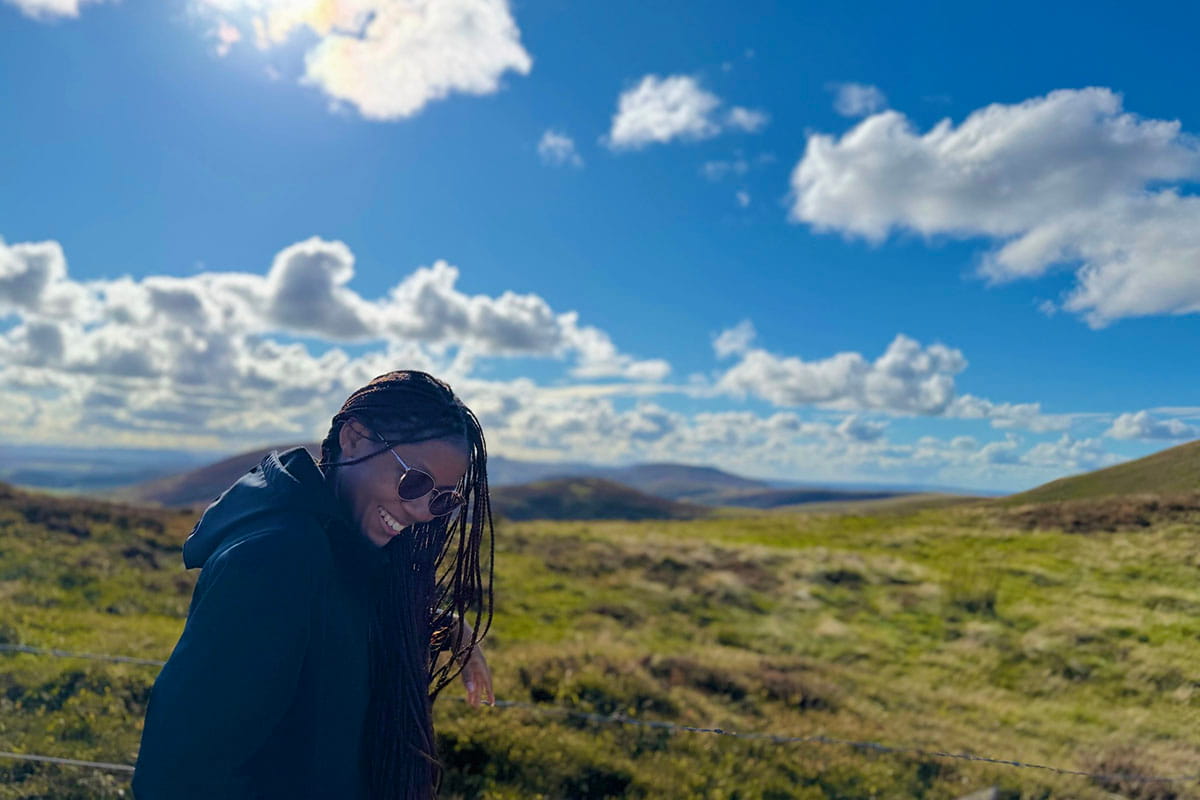
I have enjoyed sunrise walks at Portobello Beach, hikes in the Pentland Hills, and time on Arthur’s Seat, all of which have helped me feel more connected to the city. I have also loved discovering new places around Edinburgh like the cafés, bookstores, hidden walks and waterbodies. There is always somewhere worth exploring.
Even the simple routine of morning walks before class has become meaningful to me. It gives me a chance to slow down, reflect, and start the day with calm and focus.
Looking ahead
What are you hoping to do after you graduate from this programme?
Looking ahead, this Master’s programme has expanded the way I think about climate finance. At the start, I had a broad idea of the direction I wanted to take. Now, I understand just how wide and complex the field really is, and how much potential it holds.
My strongest interest lies in Article 6 and carbon markets, and particularly in how they can unlock climate finance for emerging and developing economies that are both highly exposed to climate risks and hold significant mitigation potential. I see real scope to mobilise capital in ways that support development and resilience without deepening existing debt burdens, especially in regions that are already facing acute climate impacts.
Over the next few years, I hope to build experience across international policy and advisory work around carbon pricing and transition risk. The exposure I received has given me a stronger sense of how my skills could contribute across these areas.
This programme has given me confidence, clarity, and a stronger sense of purpose. It has also made me even more excited about the possibilities ahead, particularly the chance to contribute to solutions that can make a real difference for Africa and other regions which need this the most.