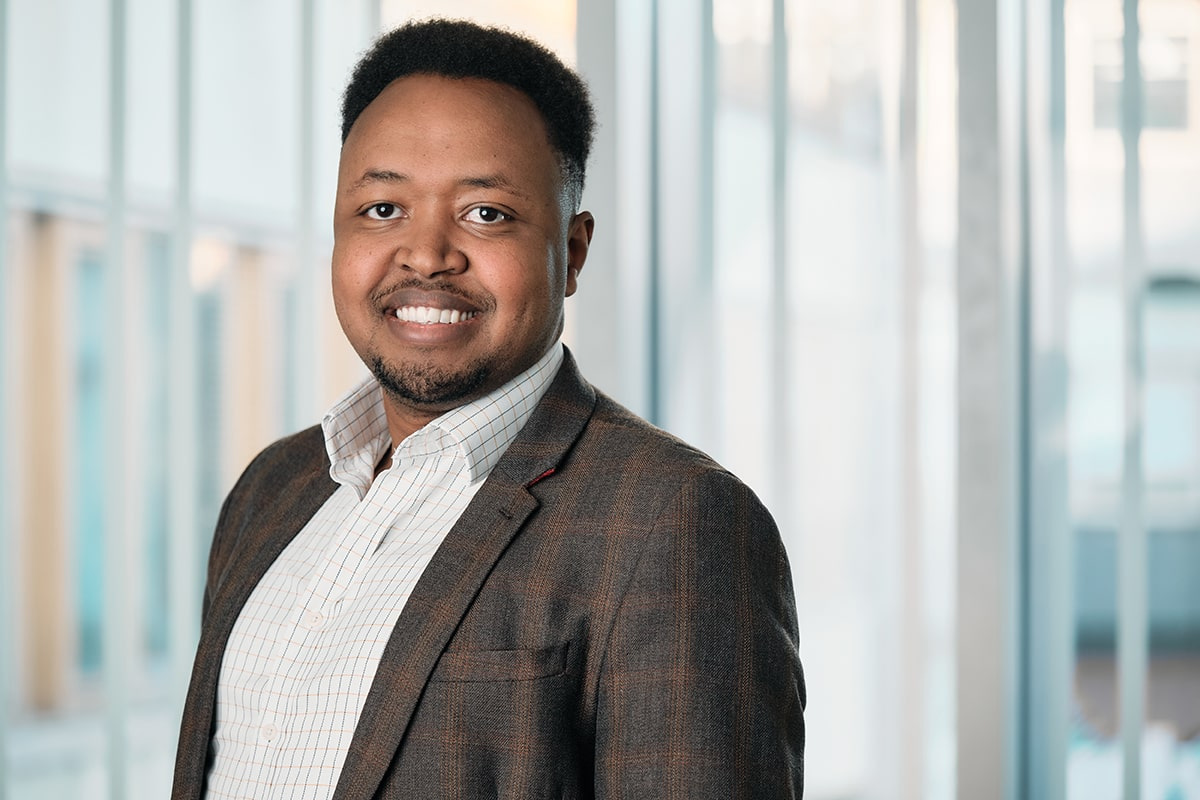
Can you give a brief summary of your career to date, and the journey that brought you to the University of Edinburgh Business School?
I was born in Kenya and schooled there until my undergraduate studies in Business and Economics. I left Kenya after my degree in 2005 to do an AIESEC graduate traineeship with a multinational corporation in Birmingham. After my traineeship I decided to join the University of Birmingham for a Masters in Economic Policy and International Business then stayed for a PhD in the Economics of Entrepreneurship and Innovation. I moved to Glasgow in 2013 to do a post-doc at the University of Strathclyde focusing on gender, ethnicity and entrepreneurship in the UK working with a range of policy-makers and industry bodies. Subsequently, I took up a lectureship at Strathclyde until 2023 when I moved East to the University of Edinburgh Business School.
If you had to give your ‘elevator pitch’ and explain your research in layperson’s terms, how would you describe it?
My research seeks to understand differences in participation, performance, experience of various aspects of entrepreneurship, mostly startup and small business ownership, among people from various sections of society, particularly people with protected characteristics. My main interest is to discover things we can do to build towards greater equality in socio-economic outcomes in and through entrepreneurship.
Is there anything exciting in the pipeline that you're currently working on?
I have done a lot of external academic engagement since my post-doc days and have found that the role of universities in society is quite poorly understood, including by universities themselves, with engagement traditionally poorly rewarded by universities and poorly regarded by industry! But recently, the situation has been changing. So, I have become increasingly interested in studying external engagement and impact as an emerging topic of research, so I have some ongoing work in that area.
What do you enjoy most about your teaching and research? What challenges or excites you across both areas?
I would say experiences of teaching and research can be quite different. With teaching, I enjoy seeing students grow and seeing their wee faces glow when an idea clicks, especially in discussions in small classes. I love engaging with students and learning from them once they have got comfortable with debating and contributing but it can be a challenge to them to get to that level quickly, especially fresh-faced first years which is why it is so rewarding to see them grow into that.
When it comes to research, I enjoy the occasional deep dive down a rabbit hole, but I can’t always indulge in them. What tends to be more productive for me is discovering interesting stories from a sea of numbers, then collaborating with other researchers and practitioners to turn those insights into meaningful actions. Even the smallest bit of impact beyond academia, whether its sparking reflection among policymakers or offering food for thought to industry practitioners, makes this process worthwhile.
What do you enjoy most about working at UEBS?
I love the camaraderie with both academic colleagues from my research group and the wider school, and colleagues in professional services who provide invaluable support in many areas, especially on how to successfully navigate complex university processes. I also enjoy the fact that the University of Edinburgh is a large institute with lots of opportunities, and I have particularly enjoyed meeting colleagues in the university-wide staff BAME network which I have found quite empowering.
What advice would you give to your younger self, just about to leave home and embark on further education?
My dad worked at a university as professional staff for 43 years and banged on about the university every night especially about how academics had it ‘so good’. So, I naively thought a career in academia would be a bed of roses. What I did not know is that those roses come with many prickly thorns too, and one needs to understand the game and carefully navigate the opportunities and challenges that come with academia. My advice to younger me would thus be to study and understand the rules of the game in higher education and take a balanced and strategic approach.
What one book, piece of music, and beloved item would you take to a desert island?
The one book I would take to a desert island is Shackleton’s Way, which I was gifted by my first proper boss Damian Drabble when I finished my traineeship in 2006. For music, I would have Eminem’s Loose Yourself on repeat. The beloved item I would take is a photo of myself and my children from years ago after a stroll at Kelvingrove in Glasgow with my then toddler son on my back while my baby daughter was in a kangaroo baby carrier on my front - reminds me how strong you can be when you have to be!
If you could invite anyone (past or present) over for dinner, who would it be and why?
David Hume, because I am a trustee of the David Hume Institute and would like to speak with him about his infamous footnote.
If you could travel anywhere in the world, where would it be and why?
Madagascar. Growing up in Kenya watching documentaries about it, I thought it was so close to home, yet so far and so fascinating in so many ways.
Research Spotlight: Dr Samuel Mwaura
Dr Samuel Mwaura (Lecturer in Entrepreneurship & Innovation) addresses significant disparities in entrepreneurship opportunities within Scotland.
Dr Samuel Mwaura’s research focuses on understanding gaps in entrepreneurship among females, ethnic minorities, and other disadvantaged communities in Scotland. In particular, he examines barriers to access to finance and other resources, and lower advancement to successful established businesses, despite relatively high start-up activity. Through engaged research and collaborative positive action, he aims to contribute to the development of more inclusive enterprise policy and local business support, towards more equitable entrepreneurship and socioeconomic wellbeing outcomes in Scotland.
[Dr Samuel Mwaura]
Hi, I'm Samuel Mwaura. I'm a lecturer at the Entrepreneurship and Innovation Group at the University of Edinburgh Business School.
The main research findings that have driven my interest and impact, are around the staggering opportunity gap in entrepreneurship in Scotland, mainly around female and ethnic minority entrepreneurship.
For example, last year we found that female entrepreneurs in Scotland had caught up with males in terms of startup activity. But when you look at established businesses, women were still 50% less likely to hold down an established business as compared to men.
And it's a similar story for ethnic minorities as well. In fact, ethnic minorities are three times more likely than white people in Scotland to set up businesses. But when you look also at the established business rates, they're actually under-represented in that. And all this boils down to very significant structural barriers and access to finance and other business support.
As a result of my work in impact firstly, among other academics and ecosystem partners in Scotland, we contributed to the UN as to what report that came out last year and that has gone on to impact policy in many ways. For example, the launch of the Ecosystem Fund that has been distributed across business organisations in Scotland.
Secondly, working with Glasgow City Council, I was involved in a policy prototyping exercise to develop programmes for supporting minority and other sort of marginalised communities in entrepreneurship in Glasgow, and in December last year, they launched the Social Innovation Challenge Fund, and I was involved in setting that up and also in the first judging panel earlier this year.
To make impact happen you have to do a lot of engagement work. Like a lot. You have to be out there, you know, networking with these, external partners, speaking their language, learning their language, building the trust and just basically building those relationships and getting your name out there.
The other thing we have to do as well is try and get those partners into the university. There's a perception that the university is an ivory tower that is, you know, snobbish, in fact, and you have to bring them in to build that trust again, so that when we send research out to them, they know where it's coming from and they get to engage with it.
The reason why I wanted to make an impact is because I've always been inspired by the old truism that knowledge is power. So intrinsically driven to try to put that knowledge to action.
In addition, for me, as an ethnic minority studying minoritised groups, the research is awakening, so it kind of makes you woke. When you become aware of the opportunity gap in entrepreneurship and all the structural barriers, you feel you've got a citizenship responsibility to do something about it.
Now, engagement and impact are really difficult, and universities have traditionally under-resourced, under-rewarded and unappreciated it. I've actually added engagement and impact as an area of research interest for me personally. And what we're finding is that academics see it as an intrinsically driven discretionary work, and universities risk mismanaging that by being too managerialist about it.
But since joining Edinburgh, I have found the Business School here really values and supports engagement, and I've benefited a lot from the support and advice I’ve received while I've been here.
All of that has really encouraged me to continue to focus on applied research in inclusive entrepreneurship, because I feel I'm enabled to go out there and create the impact that my research enables me to do.
Thank you for listening.

Lecturer in Entrepreneurship & Innovation