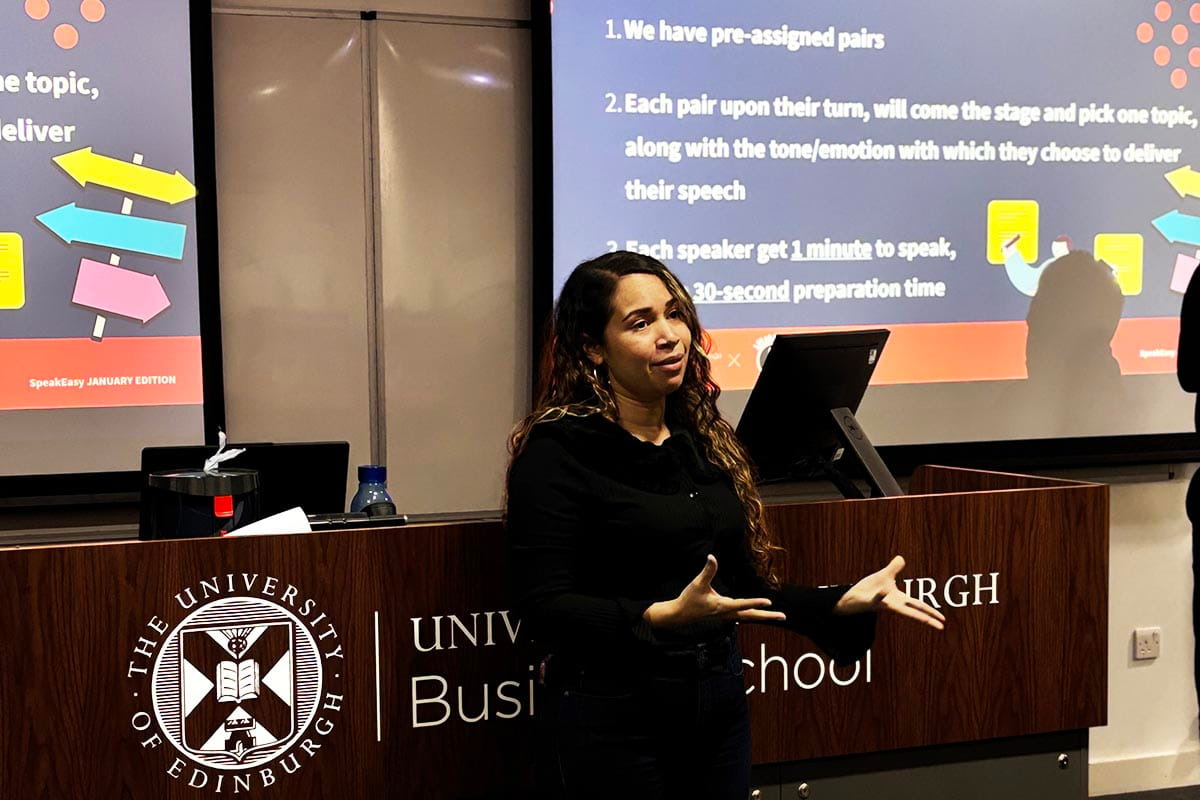
The first time I had to speak with only two minutes to prepare, I thought: this is going to be a disaster.
I was standing in a room full of students from different parts of the world at the University of Edinburgh Business School, trying to quickly structure a speech in my head - while also wondering if my accent would be clear enough for everyone to understand.
That moment didn’t turn into a disaster.
But it did turn into a turning point.
Why I chose to put myself in that position
As part of the Edinburgh Award in Global Employability, I intentionally chose public speaking as a skill to develop alongside my Masters in Entrepreneurship and Innovation.
Not because I was bad at it - but because I knew I could be better.
I’ve always believed that confidence is not something you have - it’s something you build through repetition. The student-led group Speakeasy seemed like the perfect environment: a space to practise, experiment, and improve.
What I didn’t expect was how much it would challenge the way I understood communication altogether.
The hidden fear: not about speaking, but about being understood
Before joining, my biggest concern wasn’t speaking itself - it was being understood.
In a highly international environment, I became more aware of my accent and how I express ideas. There’s a subtle pressure that comes with that: Will they follow? Will this land the way I intend it to?
And that’s where I realised something important:
Public speaking is not just about delivering a message - it’s about bridging differences.
Speakeasy was not what I expected
I expected structured speeches. Instead, I found energy, spontaneity, and unpredictability.
My first session involved interactive, almost game-like activities. At one point, I had to improvise a speech about how Google Maps makes me feel. It felt more like improv theatre than a traditional speaking exercise - and I loved it.
With only a couple of minutes to prepare, I tried to build a joke on the spot. I was nervous. But something shifted when I started speaking.
People were engaged. They laughed. They connected.
That’s when I understood something that no classroom had taught me before: Connection matters more than perfection.
Redefining what ‘good speaking’ means
Before Speakeasy, I believed good public speaking meant:
- Being structured
- Being clear
- Avoiding mistakes
Now, I see it differently.
Speakeasy exposed me to different speaking styles - some people read their speeches, others improvise, some bring humour, others bring precision. And all of them can be effective.
It made me question my original assumption:
What if being ‘good’ at speaking isn’t about fitting one model, but about owning your style?
Growth happens in the details
One of the most underrated aspects of Speakeasy is that you don’t just speak - you observe, evaluate, and support.
Taking roles like timekeeper or evaluator made me realise something powerful. Great communication is not just about the person speaking - it’s about the entire environment that supports that moment.
At the same time, consistency became my biggest challenge.
Showing up after long university days, managing energy, and participating even when I wasn’t in the mood pushed me beyond comfort. And yet, every time I showed up, it felt worth it.
From practice to real confidence
The impact didn’t stay in the room.
Recently, during a hackathon, I found myself stepping forward naturally to speak, without overthinking it. I brought energy, clarity, and presence. And for the first time, it didn’t feel forced.
It felt natural.
I’ve also noticed it in smaller moments:
- Speaking with professors more confidently
- Approaching people more easily in networking settings
- Expressing ideas with less hesitation
These are subtle shifts - but they compound.
The most important lesson
If I had to summarise everything Speakeasy has taught me, it would be this:
People are not looking for perfection - they’re looking for connection.
Everyone in the room is navigating their own fears. So when you speak, share an idea, or even make someone laugh, you’re already doing more than you think.
Who I was versus who I’m becoming
I joined Speakeasy as someone who wanted to improve.
I’m leaving as someone who is willing. Willing to speak. Willing to show up.
Willing to take opportunities - even without feeling 100% ready.
And that shift makes all the difference.
Looking ahead
In the future, I see myself in roles where communication, influence, and presence are essential. Spaces where ideas need to be shared clearly - and confidently - across cultures. Even as an international speaker.
And this experience? It feels like one of the first real steps in that direction.
Final thought
If you’re thinking about joining a society like Speakeasy but feel unsure, here’s what I would say:
- No one is there to judge you.
- Everyone is there to grow.
- So start before you feel ready.
Breathe. Relax. And give it your best shot - people will appreciate it.