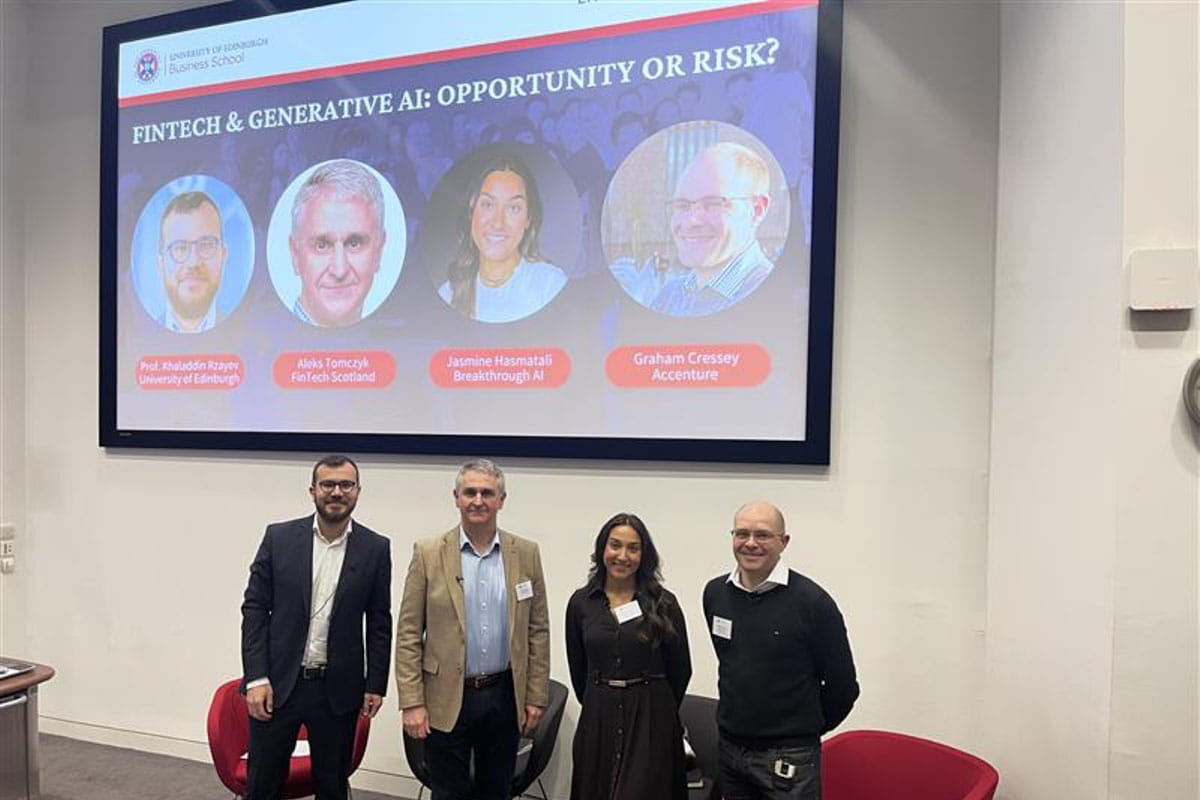
These are conditions that demand serious attention. We were therefore privileged to attend the University of Edinburgh Business School’s Business Series event, FinTech & Generative AI: Opportunity or Risk? Chaired by Professor Kaladdin Rzayev, the discussion brought together three industry professionals to examine how this technology is already affecting finance, and where its opportunities and weaknesses may lie.
Aleks Tomczyk, CEO of FinTech Scotland, opened with a strongly optimistic view of adoption, calling generative AI “a complete game changer.” Drawing on more than 20 years in the sector, he argued that its value lies not only in speed, but in the ability to improve operational efficiency, decision support, and data-driven processes across financial services. Referring to Scotland’s AI strategy, adopted on 20 March, he presented AI as a strategic lever for competitiveness rather than simply another digital tool.
Graham Cressey, Director of Accenture’s FinTech Innovation Lab UKI, reinforced this perspective from a practical standpoint. He explained how AI is already tranforming processes that previously slowed financial systems, while also enabling new forms of interaction through large language models (LLMs). His three-stage framework, moving from individual use, to organisational integration, to commercial deployment, was especially useful because it showed adoption not as a single leap, but as a process of scaling capability and learning. Yet this also raises technical concerns: once models are embedded into core workflows, issues of explainability, validation, data quality, and control become materially more important.
The event became more critical when Professor Rzayev turned to the failures that often accompany major technologies: unequal adoption, concentration of power, and weak accountability. Jasmine Hasmatali, Head of Marketing at Breakthrough Social Enterprise, brought this into sharp focus. She pointed to financial exclusion, noting that 1.4 billion people globally remain unbanked, and argued that AI could widen access. However, she also emphasised the limits of this optimism. Public trust remains fragile, particularly when models are used in sensitive domains such as personal finance, where biased training data, opaque outputs, and poor governance can produce harmful outcomes at scale.
One example discussed was the Netherlands case, where recent generation nationals were falsely flagged and therefore denied government aid because of algorithmic bias. This was a useful reminder that firms cannot treat AI outputs as neutral, objective, or beyond challenge. In finance especially, model risk is never purely technical. It becomes regulatory, ethical, and social. At the same time, Graham argued that the opportunity remains substantial. Regulatory sandboxes and controlled experimentation give firms room to test how AI can reduce cost, expand inclusion, and improve service design. Used carefully, such tools may help identify underserved customers, refine credit decisions, and support more adaptive interventions.
Aleks therefore framed regulation not as anti-innovation, but as something that must be proactive and balanced. Engagement with bodies such as the FCA reflects an attempt to protect consumers without closing off innovation. Jasmine extended this by stressing that upskilling is essential. AI literacy is not only about using the tools, but about developing the judgement to question outputs, understand limitations, and know when human oversight is necessary.
It became clear that even experienced professionals cannot answer the question, opportunity or risk, with certainty. The stronger conclusion is that it is both. For students of finance, technology, and policy, the event was immensely valuable because it showed that the future of AI in finance will depend less on the technology alone than on the quality of its governance, deployment, and oversight.