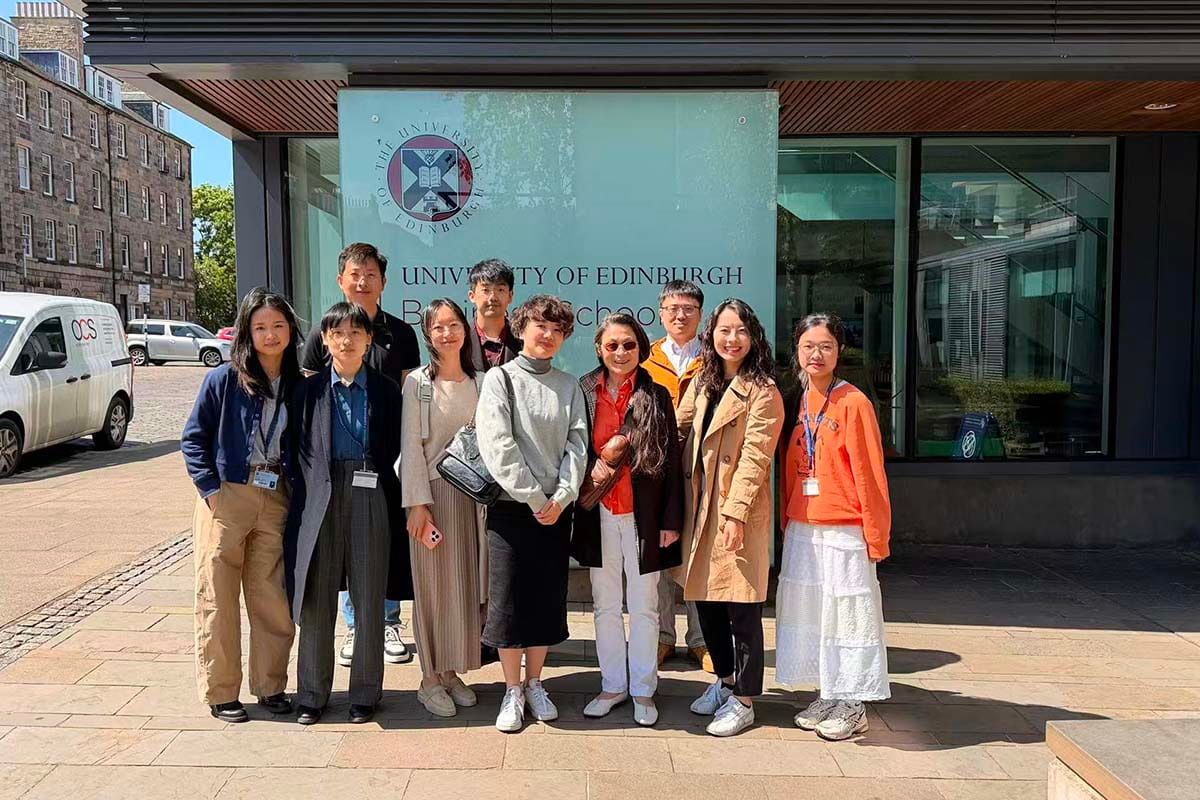
Last week, I had the pleasure of welcoming a delegation from the Shanghai Institute for Science of Science (SISS) to the University of Edinburgh Business School. The visit brought together long-standing academic colleagues and friends for discussions on science, technology, innovation, and China’s evolving digital modernity.
During the meeting, I gave a presentation on my recent book, The Imitation Paradox: Two Moral Universes and China’s Path to Digital Modernity. What made the event particularly meaningful was not simply the presentation itself, but the rich discussions that followed, in which colleagues connected the book’s themes with their own fieldwork experiences and reflections.
One discussion focused on China’s shanzhai mobile phone ecosystem in Shenzhen. A colleague shared her fieldwork experiences interviewing engineers and entrepreneurs involved in the development of early shanzhai phones. Reflecting on the book’s chapter on shanzhai innovation and knowledge sharing, she described how engineers from different firms informally collaborated, exchanged ideas, and adapted technologies to highly specific user needs.
One example concerned the emergence of dual-SIM mobile phones. Rather than being driven by abstract technological competition alone, the design responded to practical user demands, including the desire to benefit from different local mobile tariffs and service packages. Another example involved phones with louder speakers, developed for users working in noisy environments.
Particularly striking was her reflection on intellectual property and creativity. When she asked engineers whether they worried about protecting their ideas, many responded that the most exciting aspect of that period was precisely the open sharing of knowledge and the collective creation of new products. Formal protection of creativity was often seen as secondary to the energy of experimentation and participation.
Another stimulating discussion emerged around the concept of the “digital panopticon” explored in the book. A colleague specialising in legal studies raised thoughtful questions about surveillance, visibility, and governance, particularly the idea that digital observation today increasingly operates in multiple directions rather than simply “top-down.” The discussion reflected on aspects that may be underdeveloped in classical interpretations of Michel Foucault’s panopticon, especially in the context of interactive digital platforms and contemporary socio-technical infrastructures.
The gathering also included an interview discussion about the book and broader conversations on China’s technological development, platform governance, and socio-technical change. Following the meeting, colleagues visited our home for coffee and tea, allowing discussions to continue in a much more informal and personal atmosphere.
A particularly touching moment for me was receiving the certificate recognising my appointment as an Honorary Research Fellow of the Shanghai Institute for Science of Science. I was also delighted to present one of the first newly arrived copies of my book, signed for the delegation.
The visit reminded me once again that academic collaboration is not only about formal institutional exchange. It is also sustained through long-term intellectual dialogue, shared memories, friendship, and continuing efforts to understand rapidly changing socio-technical worlds together.

Xiaobai Shen is our Senior Lecturer in International and Chinese Business.